Tutorials | Workshop
2025 SACAIR Tutorials | Workshop
Please scroll down to view the Tutorial | Workshop details:
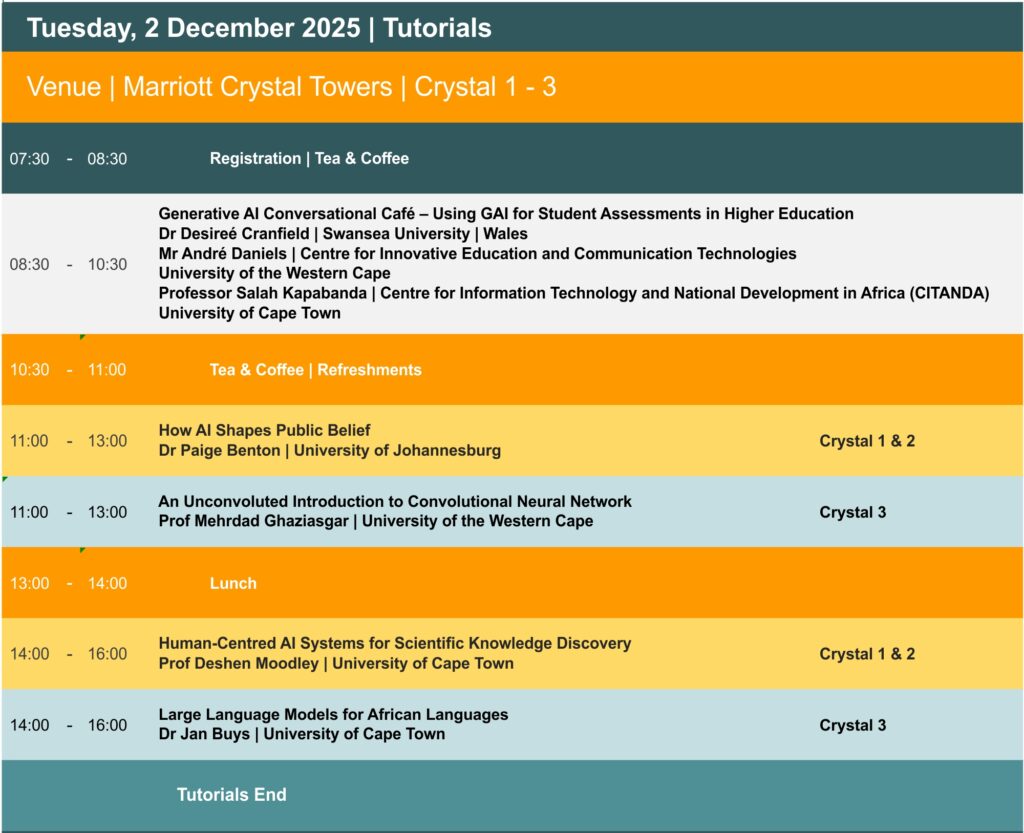
Generative AI Conversational Café | Using GAI for Student Assessments in Higher Education
Generative AI Conversational Café – Using GAI for Student Assessments in Higher Education
Dr Desireé Cranfield | Swansea University | Wales
Mr André Daniels | Centre for Innovative Education and Communication Technologies
University of the Western Cape
Professor Salah Kapabanda | Centre for Information Technology and National Development in Africa (CITANDA) | University of Cape Town
Join the “Generative AI Conversational Café” at SACAIR 2025!
Step into a dynamic, informal space where educators, researchers, and AI experts come together to explore how conversational AI is transforming student assessments in higher education.
What to Expect:
- Lightning talks (5 mins each) on real-world AI teaching practices
- Round robin discussions in small groups
- Live idea-sharing via Padlet
- A collaborative wrap-up to capture key insights
Call for Contributions:
Do you have an innovative practice or insight into using AI for student assessment? We’re inviting short 5-minute lightning talks to kick off the conversation. To contribute, email Dr. Desireé Cranfield at d.j.cranfield@swansea.ac.uk
Who should attend:
Academics and practitioners eager to share, learn, and co-create in a relaxed, interactive setting.
Bio: Desireé Cranfield
Dr. Desireé Cranfield is appointed as a Senior Lecturer and Deputy Programme Director for the Business Management UG programme within the School of Management at Swansea University, Wales. She has a Ph.D. in Knowledge Management at Southampton University, UK, and an M.Sc. in Data Communication Systems, Brunel, UK. Dr. Cranfield has completed a PGCert for teaching within Higher Education and is a fellow of the Higher Education Academy. Her academic experience spans several years, both within the UK and in South Africa, and she has undertaken several management roles within the Higher Education context. She is a HEA mentor and assessor within the university. Her research interests lie within the context of public sector organizations and she is keenly interested in the adoption and use of technology within this context to enhance learning and teaching, as well as improve processes and practices. She is also keenly interested in how knowledge sharing takes place as part of knowledge management more broadly within Higher Education, and how creating opportunities for “informal conversations” can be used as a technique to enhance practice.
Bio: André Daniels
André Daniels joined the University of the Western Cape (UWC)’s Centre for Innovative Education and Communication Technologies (CIECT) in 2005 as coordinator of Digital Media. There he supports various departmental projects and works closely with the Teaching and Learning Directorate. He has a background in Biochemistry and holds a Master’s degree in Academic Development and is involved with student and staff training and development, as well as the production of multimedia content for face-to-face and online teaching and learning. He also lectures at first-year level on a Digital Media Literacy course. His engagement with communities started with radio (C-flat Radio) and later with television (Cape Town TV). He currently serves on the board of City Mission, an Not-for-profit organization geared towards the mentoring and re-integration of ex-offenders into society in Cape Town, South Africa. He is currently engaged in a joint PHd programme between the Vrije University of Brussels (VUB) and UWC focusing on the development of 21 st century skills in higher education.
How AI Shapes Public Belief
Dr Paige Benton | University of Johannesburg
Content:
What’s the best way to parent? What should we believe? Who should we vote for? Unseen AI algorithms curate our most personal decisions and public beliefs. Public belief that is grounded in truth, knowledge and mirrors the reality of actual real-world struggles of citizens is essential for a stable democracy. Generative AI technologies shape public belief by summarising posts, news articles, and auto-generating captions, as well as providing prompts. The algorithmic influence on media, in terms of prompt structure, ideological bias, and engagement incentives, impacts how people perceive themselves and those around them, what constitutes truth, who is considered good, who should be feared, what is considered ‘normal’, and what we should value. Behind these generative outputs are engagement-maximising algorithms that reward emotionally charged clickbait content. First, they shape what people see, then they influence how people interpret, ultimately impacting what people believe. This tutorial explores these mechanisms, from headline prediction to ideologically prompting, demonstrating how easily public belief can be shaped. It is designed for interdisciplinary audiences concerned with the future of AI, media, democracy and epistemic and political agency.
Prerequisite knowledge:
All welcome!
Bio: Paige Benton
Dr Paige Benton holds a postdoctoral fellowship at the University of Johannesburg, based at the African Centre for Epistemology and Philosophy of Science. Her research lies at the intersection of political philosophy and contemporary social issues, with a focus on liberal theory, women’s rights, digital justice, and the politics of artificial intelligence. She seeks to address the evolving challenges to democratic stability. Most recently, Dr Benton was an invited panellist for the Round Table Discussion, ‘Data Commons: Creating Inclusive Data Capital and Enabling Fair Access’, hosted by United Nations Office for Digital and Emerging Technologies. She serves as a guest editor for AI & Society's Topical Collection on Indigenous Knowledge Systems and AI. She is a member of the research group at the Centre for AI and Digital Policy in Washington, DC. She is the Co-PI of a three-year project entitled ‘Safeguarding Democracy in the Age of AI’, which focuses on examining how AI technologies undermine the political and epistemic agency of citizens in the Global South.
An unconvoluted introduction to Convolutional Neural Networks
Prof Mehrdad Ghaziasgar | University of the Western Cape
Content:
Convolutional Neural Networks (CNNs) have become the foundation of modern computer vision, powering advances that define the current state of the art. They are central to object detection, recognition, and tracking across static images and dynamic sequences, but their influence extends far beyond these core tasks. CNNs enable reliable face recognition systems used in authentication technologies, drive real-time perception modules in autonomous vehicles, and support large-scale content moderation pipelines in social media platforms. In medical imaging, CNNs are employed to detect tumors, classify lesions, and assist radiologists in interpreting complex scans with a level of precision that approaches, and in certain domains even exceeds, human expertise. In manufacturing, CNN-based vision systems perform quality control by identifying defects that are imperceptible to the human eye. These are only a few of the practical applications of CNNs.
The widespread use of CNNs stems from their ability to automatically learn hierarchical feature representations that generalize across domains, in contrast to the fragile, handcrafted features of earlier vision approaches. By bridging low-level image patterns with high-level semantic concepts, CNNs have unlocked practical solutions to problems that were previously considered infeasible, firmly establishing them as indispensable tools across industries and research domains alike.
This tutorial takes a structured and visually guided approach to thoroughly explaining and demystifying the principles of CNNs from first principles. The tutorial begins by introducing and demystifying the fundamental concepts that underpin convolutional architectures, including convolution, padding, stride and others – parameters which have tormented many-an-enthusiast, and the fine-tuning of which has caused many-a-thumb to be sucked. These core ideas are then progressively connected to higher-level notions such as pooling and normalization, illustrating how each component contributes to robust feature extraction and invariance. Building on these foundations, the tutorial examines a range of established CNN architectures that have shaped the evolution of the field. Well-known designs such as LeNet, AlexNet and VGG, building to more intricate designs, including Inception and ResNets.
This tutorial is ideal for any machine learning enthusiast, ideally (but not necessarily) with some knowledge on basic neural networks. The overarching goal of the session is to provide a clear intuition into how and why CNNs function and why they are effective at processing images, especially compared to “ordinary” neural networks. By presenting both the mathematical underpinnings and the conceptual motivations in a visually accessible manner, the tutorial seeks to demystify convolutional networks and reduce the perceived complexity of their design. Participants will leave with a deeper understanding of CNN mechanisms, architectural evolution, and the language of modern convolutional models, equipping them with a solid foundation for further exploration of advanced applications in computer vision.
Prerequisite knowledge:
(Ideally) Some knowledge on neural networks such as: Gradient descent, and “Normal”/ “Vanilla” / “Plain” Neural Networks Jargon such as: Feature Weight / Bias, Hidden Layer, Activation Function (ReLU), Softmax and Regression/Classification.
(Realistically) This talk can still be very useful even if you don’t have the above ideal pre-requisites.
Bio: Mehrdad Ghaziasgar
Human-Centred AI Systems for Scientific Knowledge Discovery
Prof Deshen Moodley | University of Cape Town
Content:
The notion of Human Centred Artificial Intelligence (HCAI) systems is increasingly gaining traction in the AI research community. In HCAI the primary design goal is to amplify or augment human cognitive capabilities rather than to replace it. Human Computer AI systems are emerging at the intersection of three disciplines Artificial Intelligence (AI), Cyber-Physical Systems (CPS) and Human Computer Interaction (HCI). From a systems perspective AI algorithms from a core component of a broader distributed cyber-physical system incorporating new mechanisms for human interaction. One example of such an HCAI system is an AI driven 3D digital twin. Within the AI research community, systems that can discover new scientific knowledge are regarded by many as the next big leap forward. But can we truly design AI systems capable of formulating new hypotheses and discovering new knowledge? Will these systems really be capable of experiencing and understanding the world? If so, what will happen to human scientists?
In this tutorial, I will introduce Human Centred AI systems and provide some insight into some of the above questions. Drawing from some of our previous and current work on AI systems for sustainable development across the health, energy, biodiversity, and earth observation domains, I will describe different architectures and approaches for HCAI systems for scientific knowledge discovery, continuous learning and interactive decision-making. I will provide some insights into some new and emerging paradigms including Urban AI and Imaginative AI systems.
Prerequisite knowledge:
Awareness of different AI techniques would be useful but not mandatory.
Bio:
Deshen Moodley is the SARChI Chair in Artificial Intelligence (AI) systems, an Associate Professor in the Department of Computer Science at the University of Cape Town (UCT). He also serves as the Director of UCT’s AI Research Unit and the co-director and co-founder of South Africa’s national Centre for Artificial Intelligence Research (CAIR). His research focusses on architectures for human centred AI systems. His current work explores novel mechanisms for adaptation, cognition and interaction in AI systems to enable scientific knowledge discovery, continuous learning and interactive decision making. He has worked on AI systems in diverse application domains, including the health, energy, finance and earth observation domains. He spent the 2023/2024 academic year as a Research Fellow at the Paris Institute for Advanced Study, where he still maintains an affiliation as an Editorial Fellow.
Large Language Models for African Languages
Dr Jan Buys | University of Cape Town
Content:
Large Language Models (LLMs) have transformed the landscape of Natural Language Processing (NLP) research and applications as unified models that can handle a wide range of language understanding and generation tasks. In recent years, LLMs have become the most prominent and widely used AI technology, being used more broadly for tasks beyond traditional NLP such as coding, and as general purpose chatbots, search engines and everyday assistants. Many LLMs are now multilingual, but a performance gap remains between high-resource languages such as English and low-resource languages which include most African languages.
This tutorial will cover the main steps of LLM development, including data curation, pretraining, instruction fine-tuning, and Reinforcement Learning from Human Feedback. We will give an overview of the main model architectures, fine-tuning methods, and decoding strategies. Then we will review currently available datasets and resources for developing LLMs for African languages, and discuss the main current research challenges in LLMs for low-resource languages. By the end of this tutorial participants will have practical knowledge of the techniques, datasets, and tools needed to develop or adapt LLMs for African languages.
Prerequisite knowledge:
Some knowledge of machine learning and neural networks is recommended.
